


Early Signs of Urinary Bladder Cancer What to Watch and When to Act
Recognising early signs of urinary bladder cancer can save lives. This comprehensive guide explains blood in urine, urinary changes, advanced symptoms, risk factors, and the differences in how bladder cancer appears in men vs women. Learn when to seek medical help, how diagnosis is done, and where Apollo24|7 can support timely testing and evaluation.


Introduction
Seeing blood in your urine or needing to rush to the bathroom more often can be frightening. Many urinary problems are caused by infections or kidney stones—but sometimes they are early indicators of urinary bladder cancer. The most common early warning sign is painless blood in the urine, even if it appears once and vanishes. Other, more subtle clues—sudden urinary urgency, burning, or discomfort without a clear infection—can also occur.
Because these symptoms overlap with common issues like urinary tract infections, bladder cancer is sometimes missed or diagnosed late. But early detection significantly improves outcomes, often allowing less invasive treatment and better quality of life.
This guide helps you understand which signs are worth urgent attention, how they differ in men and women, what happens at the doctor’s visit, and how bladder cancer is diagnosed. You will also learn practical steps you can take while awaiting evaluation. If symptoms persist beyond two weeks, consult a doctor online with Apollo 24|7, and if needed, book a physical consultation with a urologist for timely care and testing.
Consult a Top Nephrologist for Personalised Advice
What Is Urinary Bladder Cancer?
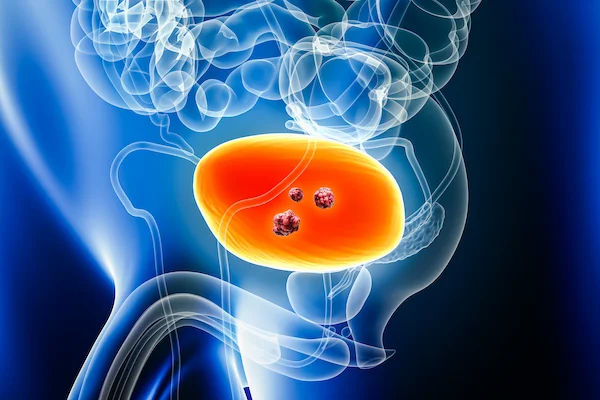
Bladder cancer begins in the cells lining the bladder and commonly causes bleeding and irritation during urination.
Urinary bladder cancer starts when cells in the bladder lining grow uncontrollably and form a tumour. The bladder stores urine made by the kidneys and releases it when you urinate. Most cancers begin in the urothelium—the smooth inner lining—making urothelial (transitional cell) carcinoma the most common type.
Other, less frequent types include:
• Squamous cell carcinoma — linked to chronic inflammation
• Adenocarcinoma — arises from rare gland-like cells
The reason bladder cancer causes urinary symptoms is simple: tumours irritate the bladder or bleed into the urine. This leads to blood in urine (haematuria), burning, urgency, and frequency—symptoms often mistaken for infection.
Early diagnosis matters because many tumours are found before spreading into muscle. Detecting changes early dramatically improves outcomes.
How Your Bladder Works
The bladder is a muscular balloon. As it fills, nerves signal the brain. When you urinate, the bladder muscles tighten, and the sphincter relaxes. Tumours disrupt this balance, causing irritative symptoms.
Why Early Recognition Matters
Non–muscle-invasive disease is highly treatable. Muscle-invasive disease is more dangerous and often requires major treatment. Acting early protects options and life expectancy.
Who Is at Risk? Understanding Factors That Raise Your Chances
Some lifestyle factors, medical history, and environmental exposures significantly increase risk.
Anyone can develop bladder cancer, but your risk is higher if you have:
• Smoking history — the strongest risk factor; chemicals in smoke are filtered into urine
• Occupational exposure — paint, dyes, rubber, leather, printing and metal workers
• Age — risk increases after 45–50
• Sex — more common in men but often diagnosed later in women
• Chronic irritation — recurrent infections, indwelling catheters, bladder stones
• Past pelvic cancer treatment — including radiation or certain chemotherapy drugs
• Family history or genetic conditions
Helpful Tip: Create a “risk snapshot” to share with your doctor — jobs, chemical exposures, years smoked, history of pelvic treatments, and any long-term bladder issues.
The Most Common Early Sign: Blood in Urine (Haematuria)
Even a single episode of visible blood in urine requires medical attention.
Haematuria appears in two ways:
• Visible (gross) haematuria — urine turns pink, red, or cola-coloured; sometimes with clots. Often painless and intermittent.
• Microscopic haematuria — detectable only during urine testing.
Why it may come and go: small tumours may bleed one day and stop the next. Do not assume all is well simply because urine looks normal later.
When to act
• Any visible blood in urine = urgent evaluation
• Especially if you are over 40 or have known risk factors
Photographing discoloured urine (if safe) can help clinicians understand what you experienced.
Other Early Urinary Changes You Shouldn’t Ignore
Subtle bladder irritation can be an early red flag.
Bladder tumours may cause:
• Sudden urinary urgency or frequency
• Burning or pain when urinating (without confirmed infection)
• Recurrent “UTIs” not responding well to antibiotics
• Night-time urination more than usual
Symptoms that do not match typical UTI patterns should raise suspicion.
Self-monitoring strategy
Track a one-week diary noting:
• Time and number of urinations
• Pain or burning
• Colour or clots
• Leakage or urgency episodes
This helps a doctor distinguish among infection, stone disease, and cancer.
Less Common or Advanced Signs of Bladder Cancer
Symptoms may expand beyond the bladder as the disease progresses.
Possible advanced signs include:
• Lower abdominal, pelvic, or flank pain
• Blocked urine flow leading to kidney swelling
• Leg swelling
• Persistent fatigue, weakness or unexplained weight loss
• Bone pain or a chronic cough if cancer spreads
Seek urgent care if:
• Bleeding becomes heavy with clots
• You cannot urinate
• Severe flank pain with fever develops
A combination of symptoms appearing together is more concerning than one symptom alone.
How Symptoms Can Differ in Women vs Men and by Age
Biological differences influence how symptoms are interpreted and diagnosed.
Women
• Symptoms are often mistaken for gynaecological issues or UTIs
• Can face a delayed diagnosis due to misattribution
Men
• Bleeding may be incorrectly blamed on prostate enlargement
• Persistent burning or clots should prompt evaluation
Older Adults
• Microscopic haematuria should never be dismissed as ageing
Younger People
• Rare but possible — persistent symptoms merit a full workup
✅ Insight: If UTIs recur despite treatment, insist on proper imaging and cystoscopy.
When to See a Doctor and What to Expect at the Visit
Early evaluation leads to faster answers and better outcomes.
See a doctor if:
• You notice visible blood in urine — even once
• Symptoms persist beyond 1–2 weeks
• UTIs repeatedly recur or cultures are negative
• Pain occurs with urinary symptoms
What will the doctor assess?
• Detailed symptom history
• Smoking/exposure history
• Urinalysis and possibly urine cytology
• Referral for imaging or cystoscopy
Healthcare access support
If symptoms persist for more than two weeks, consult a doctor online via Apollo 24|7. If symptoms continue despite treatment, book an in-person visit for timely tests and a urology referral.
How Bladder Cancer Is Diagnosed
Diagnosis combines urine testing, imaging, and direct examination of the bladder.
Key investigations
• Urinalysis and culture — detect blood and infection
• Urine cytology — checks for abnormal cancer cells
• Cystoscopy — a camera to inspect the bladder; biopsy confirms diagnosis
• Imaging — ultrasound or CT urogram to view the urinary tract
🧪 Easy logistics: Apollo 24|7 offers home sample collection to speed up early testing.
Enhanced Techniques
Some centres use blue-light cystoscopy to identify difficult-to-see tumours like carcinoma in situ.
Staging and Types: What Your Symptoms Might Suggest
Symptoms give clues, but staging after biopsy provides definitive information.
Tumours may be:
• Non–muscle-invasive — confined to inner layers; often treated with TURBT and intravesical therapy
• Muscle-invasive — spreads deeper; needs combined treatment such as surgery and chemotherapy
Irritative symptoms can signal flat, aggressive lesions like carcinoma in situ — even if imaging seems normal.
Important: Symptom intensity does not reliably indicate cancer stage.
What Else Could It Be? Conditions That Mimic Bladder Cancer
Many common urinary conditions share similar symptoms.
Conditions that overlap include:
• UTIs
• Interstitial cystitis (painful bladder syndrome)
• Kidney or bladder stones
• Benign prostate enlargement in men
• Menstrual or exercise-related blood contamination
Rule of thumb:
If symptoms repeat without a clear infection, escalate to a urologist.
Practical Steps While You’re Awaiting Evaluation
Simple measures help symptom tracking and comfort.
• Maintain good hydration
• Avoid strenuous exercise if it triggers haematuria
• Review medications and supplements
• Quit smoking to protect health and treatment outcomes
• Keep a symptom diary and photographic documentation if possible
Empowered self-monitoring speeds up diagnosis.
Myths vs Facts About Urinary Bladder Cancer Signs
Correcting misconceptions prevents dangerous delays.
| Fact |
Blood in urine always means infection | Infection is common, but painless haematuria must be investigated |
No pain means nothing serious | Bladder cancer can be painless early on |
Women rarely get bladder cancer | Women do get bladder cancer, but face delayed diagnosis |
Urine cleared up — no need to worry | Bleeding can be intermittent |
Knowing the truth encourages timely evaluation.
Prevention and Early Detection Tips
Many risk factors are avoidable or manageable.
• Don’t smoke and avoid secondhand smoke
• Wear protection if working with chemicals
• Manage chronic bladder irritation early
• Ask direct questions if blood in urine occurs
• There is no routine screening — evaluation must be symptom-driven
Early awareness is a powerful defence.
Talking to Your Doctor: Key Questions to Ask
Having a plan leads to clearer and faster care decisions.
• What tests should I have to investigate haematuria?
• Do I need a cystoscopy and when can it be scheduled?
• Which scan is best for me — ultrasound or CT urogram?
• What are follow-up timelines and next steps?
• Can Apollo 24|7 help coordinate testing and specialist visits?
Keeping control of the process builds confidence.
Conclusion
Early urinary bladder cancer often appears silently, most notably through painless, sometimes intermittent blood in the urine. Other subtle sign,s like recurring urgency or burning without infection can also be meaningful. Because these are commonly attributed to everyday conditions such as UTIs or prostate issues, diagnosis can be delayed, especially in women. Early identification, however, makes a tremendous difference. Most tumours diagnosed before they spread into muscle are highly treatable, offering better outcomes and a greater chance of preserving bladder function.
If you see visible blood in your urine, even once, or if urinary symptoms continue for more than two weeks, take action. A proper evaluation should include urine testing and, when indicated, imaging and cystoscopy. Some causes are benign, but only a thorough assessment distinguishes between harmless and serious issues. If symptoms persist beyond two weeks, you can consult a doctor online with Apollo 24|7 for professional guidance, and arrange a timely in-person visit if further evaluation is required. Home sample collection through Apollo24|7 can also help fast-track preliminary assessments.
Listening to your body is your first line of protection. Track what you notice, ask the right questions, and seek care early. Whether the final diagnosis is bladder cancer or something less concerning, timely attention leads to better health and peace of mind.
Consult a Top Nephrologist for Personalised Advice
Consult a Top Nephrologist for Personalised Advice

Dr. S. Anil Kumar Patro
Nephrologist
14 Years • MD, DNB
Chinagadila
Apollo Hospitals Health City Unit, Chinagadila

(25+ Patients)

Dr. Boddanapu Mastan Valli
Nephrologist
9 Years • M.D, D.M.
Nellore
Apollo Speciality Hospitals, Nellore

Dr. Umesh Chandra Sahu
Nephrologist
32 Years • MBBS,MD ( General Medicine ). Sr. Consultant ( Nephrology )
Rourkela
Apollo Hospitals, Rourkela, Rourkela

Dr. Mohan Patel
Nephrologist
7 Years • MBBS MD (Med) DM (Nephro) FASN, FISN, ANIO
Nashik
Apollo Hospitals Nashik, Nashik
(25+ Patients)

Dr. Manju Kamal
Nephrologist
12 Years • MBBS,MD(General Medicine), DNB,DM(Nephrology)
Angamaly
Apollo Hospitals Karukutty, Angamaly
Consult a Top Nephrologist for Personalised Advice
Dr. S. Anil Kumar Patro
Nephrologist
14 Years • MD, DNB
Chinagadila
Apollo Hospitals Health City Unit, Chinagadila
(25+ Patients)
Dr. Boddanapu Mastan Valli
Nephrologist
9 Years • M.D, D.M.
Nellore
Apollo Speciality Hospitals, Nellore
Dr. Umesh Chandra Sahu
Nephrologist
32 Years • MBBS,MD ( General Medicine ). Sr. Consultant ( Nephrology )
Rourkela
Apollo Hospitals, Rourkela, Rourkela
Dr. Mohan Patel
Nephrologist
7 Years • MBBS MD (Med) DM (Nephro) FASN, FISN, ANIO
Nashik
Apollo Hospitals Nashik, Nashik
(25+ Patients)
Dr. Manju Kamal
Nephrologist
12 Years • MBBS,MD(General Medicine), DNB,DM(Nephrology)
Angamaly
Apollo Hospitals Karukutty, Angamaly
More articles from Bladder Cancer




Frequently Asked Questions
1) Is painless blood in urine always cancer?
A.No, but it must always be evaluated. Infections, stones and other causes exist — but cancer must be ruled out.
2) Can bladder cancer feel like a UTI?
A.Yes. Similar symptoms can lead to misdiagnosis when cultures are negative or symptoms recur.
3) How is bladder cancer confirmed?
Through cystoscopy and biopsy. Urine tests and imaging support diagnosis.
4) Do women have different symptoms?
Signs are similar but misattribution to UTIs often leads to delayed diagnosis.
5) If bleeding stops, am I still at risk?
Yes. Intermittent bleeding is common. Evaluation is essential even if urine clears.