


Bhadrasana: Steps & Benefits
Learn Bhadrasana (Butterfly Pose) with easy steps, safety tips, and science-backed Bhadrasana benefits for stress relief, hips, and posture.

Introduction
If you spend lots of time sitting, your hips, lower back, and shoulders can feel stiff and tired. Bhadrasana, often called Butterfly Pose or Bound Angle Pose, is a simple, seated yoga posture that many people use to gently open the hips and relax the mind. Curious about bhadrasana benefits? This guide explains how to practice the pose step by step, how to make it comfortable with props, and what science says about its potential benefits for stress, mobility, and posture.
What is Bhadrasana?
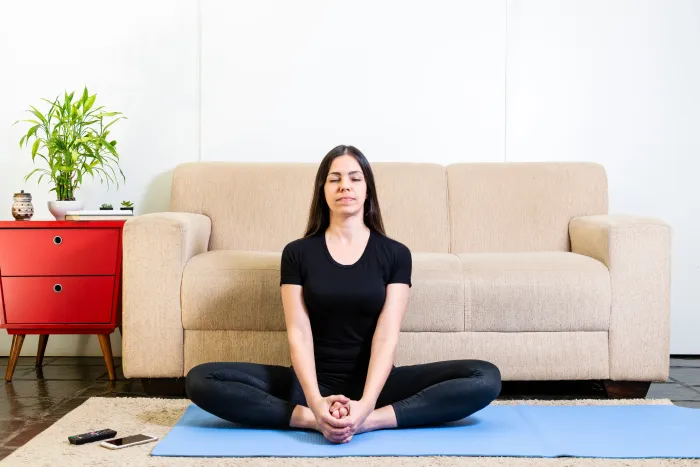
Bhadrasana (Sanskrit: “gracious pose”) is a seated position where you bring the soles of your feet together and let your knees gently fall out to the sides. In many contemporary yoga classes, it’s commonly referred to as Butterfly Pose or Bound Angle Pose. It’s beginner-friendly, can be done almost anywhere, and works well as a warm-up, cool-down, or calming break during the day.
How to do Bhadrasana?
These are the following steps that need to be followed:
1) Set Up Your Seat
• Sit on the floor with your legs extended in front of you.
• If your lower back rounds, sit on a folded blanket, yoga block, or firm cushion to lift your hips. This helps you lengthen your spine comfortably.
2) Bring Your Feet Together
• Bend your knees and bring the soles of your feet together, letting the knees open to the sides.
• Hold your ankles or feet lightly. Keep your shoulders relaxed.
3) Align Your Spine
• Sit tall without forcing a backbend. Imagine your sternum lifting gently as your tailbone roots down.
• Keep your chin level so the back of your neck stays long.
4) Find Your Comfortable Edge
• Let gravity draw the knees toward the floor. Avoid pressing on your knees with your hands.
• If your hips feel tight or your knees are high, slide yoga blocks, pillows, or rolled towels under your thighs for support.
5) Breathe and Stay
• Inhale through the nose, lengthening the spine.
• Exhale gently, softening the hips and shoulders.
• Stay for 30–60 seconds to start, and work up to 2–5 minutes if comfortable.
6) To Exit
• Support your knees with your hands and bring them together.
• Extend your legs forward and shake them out gently.
Helpful Cues
These are a few of the helpful cues:
• Think “long spine, relaxed shoulders.”
• Keep the front ribs soft to avoid overarching your back.
• If your knees or hips feel pinched, add support under your thighs or sit higher.
Popular Variations and Props
Here are a few popular variations:
• Reclined Butterfly (Supta Baddha Konasana): Lie on your back with soles of feet together and knees wide. Place pillows under your thighs and a folded blanket under your head.
• Wall support: Sit with your back against a wall for extra support.
• Strap support: Loop a yoga strap around your sacrum and the outer edges of your feet to support the legs and ease hip effort.
• Dynamic Butterfly: Gently flutter the knees up and down with small, comfortable movements to warm the hips.
Safety Tips before You Begin
Here are a few safety tips before you:
• Move into a stretch, not pain. You should feel mild-to-moderate sensation in the inner thighs or hips, but no sharp or pinching pain.
• Protect your knees. If your inner thighs feel tight, support your thighs with blocks or pillows. Never push down on your knees.
• Back care. If your lower back is sensitive, sit on a folded blanket or practice the reclined variation.
• Medical conditions and pregnancy. If you have hip, knee, or back injuries, have had recent surgery, or are pregnant, check with your healthcare professional or a qualified instructor before trying new poses. Modify as needed.
Consult a Top General Physician
Bhadrasana Benefits: What Does Science Say?
High-quality studies on this specific pose are limited. However, research from reputable medical organisations shows that yoga and gentle movement can support physical and mental well-being. Here’s how bhadrasana benefits may fit into that bigger picture:
1) Stress Relief And Relaxation
• What We Know: Yoga, Which Combines movement, breath, and mindfulness, can reduce stress and promote relaxation.
• Why Bhadrasana helps: It’s a calm, grounded pose that pairs well with slow breathing, making it a useful posture for winding down.
• Evidence snapshot: Major health organisations highlight yoga’s role in stress management and overall well-being.
2) Gentle Hip Mobility And Flexibility
• What we know: Regular physical activity that includes flexibility and mobility work supports joint health and functional movement.
• Why Bhadrasana helps: The pose places the hips and inner thighs (adductors) in a gentle, externally rotated position, encouraging gradual flexibility over time when practised consistently and comfortably.
• Practical tip: Using props under your thighs can make the stretch safer and more accessible.
3) Posture Awareness And Sitting Comfort
• What we know: Many people develop a rounded posture from prolonged sitting. Yoga can help build body awareness and postural support.
• Why Bhadrasana helps: Practising a neutral spine while seated can encourage better posture habits and strengthen attention to alignment.
4) Mind-Body Connection And Mood
• What we know: Mind-body practices like yoga are linked with improved mood and lower perceived stress levels.
• Why Bhadrasana helps: Its simplicity allows you to focus on breath and body awareness, which can be calming and centring.
5) Support For Back Comfort As Part Of A Program
• What we know: Some forms of yoga can help manage chronic low back pain when practised safely and regularly.
• Why it matters: While Bhadrasana alone is not a treatment, it may be a comfortable component of a broader, evidence-based routine designed by a professional.
Top Tips To Get The Most From Bhadrasana Benefits
Top tips to get the most from benefits are:
• Warm up first: Gentle hip circles or a few minutes of walking can prepare your muscles.
• Use props without hesitation: Comfort encourages consistency.
• Breathe slowly: Try 4–5 second inhales and exhales to support relaxation.
• Be consistent: Short, regular practice often beats occasional long sessions.
• Balance your routine: Pair Bhadrasana with poses that strengthen the core and back for better overall support.
Common Mistakes And How to Fix Them
A few common mistakes include:
• Rounding the lower back: Sit on a folded blanket or lean against a wall to lengthen your spine comfortably.
• Forcing the knees down: Never push on the knees; support the thighs instead.
• Holding the breath: Keep your breath smooth and even to reduce tension.
• Overreaching forward: A slight forward hinge can be okay, but prioritise a long spine over depth.
Who Should Be Cautious Or Modify?
It's important to be cautious for:
• People with recent hip, knee, or groin injuries
• Individuals with lower back pain that worsens when sitting
• Pregnant individuals (especially later trimesters): Practice with props, more upright support, or consider the reclined version. Always follow your clinician’s guidance.
When And How Often To Practice?
Ways to practice for bhadrasana:
• Frequency: 3–5 days per week can be helpful for mobility and relaxation.
• Duration: 1–3 minutes per session is a good start; longer if comfortable.
• Timing: After a warm-up, at the end of a practice, or as a mid-day break to reset posture and calm the mind.
A Short, Calming Breath Sequence For Bhadrasana:
• Inhale slowly through the nose for a count of 4.
• Exhale slowly through the nose for a count of 4–6.
• Repeat for 6–10 rounds. If you feel dizzy or uncomfortable, breathe naturally.
A Simple Sequence Featuring Bhadrasana:
• Cat–Cow (1 minute)
• Low Lunge (each side, 30–60 seconds)
• Bhadrasana (1–3 minutes)
• Seated Forward Fold with soft knees (30–60 seconds)
• Supine Twist (each side, 30–60 seconds)
• Relaxation (1–3 minutes)
Consult a Top General Physician
Consult a Top General Physician

Dr. Rajib Ghose
General Physician/ Internal Medicine Specialist
25 Years • MBBS
East Midnapore
VIVEKANANDA SEBA SADAN, East Midnapore

Dr. Impana G N
Physician/ Internal Medicine/ Covid Consult
11 Years • MBBS,DNB FAMILY MEDICINE, MNAMS ,CCEBDM
Mysuru
Apollo BGS Hospital Adichuchanagiri Road, Mysuru

Dr Aakash Andgi
General Physician/ Internal Medicine Specialist
9 Years • MBBS MD
Bengaluru
Apollo Clinic, JP nagar, Bengaluru

Dr. Abhishek Gowda
General Physician/ Internal Medicine Specialist
3 Years • MBBS MD General Medicine
Bengaluru
PRESTIGE SHANTHINIKETAN - SOCIETY CLINIC, Bengaluru

Dr. Soumen Paul
General Practitioner
24 Years • MBBS
Kolkata
MCR SUPER SPECIALITY POLY CLINIC & PATHOLOGY, Kolkata

(25+ Patients)
Consult a Top General Physician
Dr. Rajib Ghose
General Physician/ Internal Medicine Specialist
25 Years • MBBS
East Midnapore
VIVEKANANDA SEBA SADAN, East Midnapore
Dr. Impana G N
Physician/ Internal Medicine/ Covid Consult
11 Years • MBBS,DNB FAMILY MEDICINE, MNAMS ,CCEBDM
Mysuru
Apollo BGS Hospital Adichuchanagiri Road, Mysuru
Dr Aakash Andgi
General Physician/ Internal Medicine Specialist
9 Years • MBBS MD
Bengaluru
Apollo Clinic, JP nagar, Bengaluru
Dr. Abhishek Gowda
General Physician/ Internal Medicine Specialist
3 Years • MBBS MD General Medicine
Bengaluru
PRESTIGE SHANTHINIKETAN - SOCIETY CLINIC, Bengaluru
Dr. Soumen Paul
General Practitioner
24 Years • MBBS
Kolkata
MCR SUPER SPECIALITY POLY CLINIC & PATHOLOGY, Kolkata
(25+ Patients)
More articles from General Medical Consultation

Frequently Asked Questions
1. What are the main bhadrasana benefits?
Bhadrasana can support relaxation, gentle hip mobility, and posture awareness. As part of a regular yoga routine, it may contribute to stress management and general well-being. Use props and steady breathing for best results.
2. How long should I hold Bhadrasana?
Begin with 30–60 seconds and increase to 2–5 minutes as comfortable. If you feel numbness, sharp pain, or tingling, come out of the pose and adjust with props.
3. Is Bhadrasana safe during pregnancy?
Many people practice a supported, upright version or the reclined, well-propped variation. Always get individual guidance from your prenatal care provider and a qualified instructor, and avoid any position that feels unstable or uncomfortable.
4. Can Bhadrasana help with knee pain?
It should not cause knee pain. If you feel knee discomfort, raise your hips, place support under your thighs, reduce the range, or skip the pose. For ongoing knee issues, consult a healthcare professional for personalized advice.
5. Is Bhadrasana the same as Butterfly Pose or Bound Angle Pose?
In many modern classes, yes, the terms are often used interchangeably. The key setup is the same: soles of the feet together, knees wide, and a long, comfortable spine.