


Tay Sachs Disease: Causes, Symptoms, and Genetic Links
Tay-Sachs disease is a rare genetic disorder caused by HEXA gene mutations. Learn its causes, inheritance pattern, symptoms, diagnosis, and options for prevention and care.

Written by Dr. Siri Nallapu
Reviewed by Dr. Md Yusuf Shareef MBBS, Advanced Certificate Course in Dermatology
Last updated on 13th Jan, 2026
Introduction
Tay-Sachs disease is a heartbreaking, rare genetic disorder that primarily affects infants, leading to a progressive and irreversible destruction of the nervous system. For parents and families, understanding what leads to the signs of Tay-Sachs disease is the first step in grasping the condition's profound impact.
This article will demystify the complex genetic mechanisms behind Tay-Sachs, breaking down the science into understandable terms. We will walk through the precise genetic mutation responsible, explain how this single error triggers a devastating chain reaction in the body, and detail the timeline of symptoms that follow.
Furthermore, we will cover crucial information on carrier screening, diagnosis, and management, providing a comprehensive guide for anyone seeking to learn more about this condition. If you have concerns about genetic risks based on family history, consulting a genetic counsellor or a doctor online with Apollo24|7 can provide personalised guidance.
What is Tay-Sachs Disease? A Basic Overview
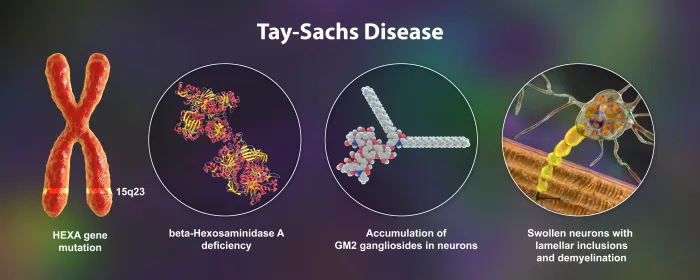
Tay-Sachs disease (TSD) is classified as a lysosomal storage disorder. Imagine the lysosomes in our cells as tiny recycling centres. Their job is to break down waste products and old cell parts. In TSD, a crucial enzyme called beta-hexosaminidase A is missing or severely deficient. This enzyme's specific task is to break down a fatty substance called GM2 ganglioside. Without it, this substance accumulates to toxic levels in the brain and spinal cord's nerve cells, causing irreversible damage and leading to the severe neurological symptoms characteristic of the disease.
The Role of the HEXA Gene
The instructions for making the beta-hexosaminidase A enzyme are carried by a gene called HEXA. A healthy HEXA gene ensures the enzyme functions correctly. Tay-Sachs disease occurs when a child inherits two mutated copies of the HEXA gene, one from each parent.
Understanding the Autosomal Recessive Pattern
This inheritance pattern is called autosomal recessive. Autosomal means the gene is located on one of the autosomes (non-sex chromosomes), so it affects males and females equally. Recessive means that a person needs two copies of the mutated gene to have the disease. Individuals with just one mutated copy are called carriers. Carriers are typically healthy and show no signs of Tay-Sachs because their one functional gene produces enough enzyme to prevent GM2 buildup.
Consult Top Doctors for Personalised Advice
The Root Cause: A Genetic Mutation
At the centre of Tay-Sachs disease lies a mutation in the HEXA gene on chromosome 15. Over 130 different mutations in this gene have been identified that can cause TSD, disrupting the enzyme's production or function. This is not a disease caused by environmental factors, diet, or anything the parents did during pregnancy. It is purely a genetic lottery with tragic consequences.
How the HEXA Gene Mutation Leads to Symptoms
The process from genetic error to visible symptom follows a clear biochemical pathway.
1. The Buildup of GM2 Ganglioside
Normally, GM2 ganglioside is produced and broken down continuously as part of healthy nerve cell development and function. In a child with TSD, the breakdown process halts. The GM2 ganglioside has nowhere to go, so it steadily accumulates inside the lysosomes of the nerve cells.
2. The Destruction of Nerve Cells
As the lysosomes swell with this undigested fatty material, they increasingly impair the nerve cell's ability to function. Eventually, the cell becomes so damaged that it dies. This widespread death of nerve cells throughout the brain and spinal cord leads to the catastrophic failure of neurological functions, manifesting as the signs and symptoms of Tay-Sachs.
Recognising the Signs and Symptoms of Tay-Sachs
The symptoms of Tay-Sachs are the direct result of progressive neurological damage.
Classic Infantile Tay-Sachs: A Timeline of Progression
The most common form, classic infantile Tay-Sachs, follows a predictable timeline.
1. Early Signs (3-6 months)
A seemingly healthy newborn begins to show subtle clues. Parents might notice an exaggerated startle response to sudden noises, listlessness, and a delay in reaching motor milestones like sitting up or rolling over. A pivotal early sign is the appearance of a cherry-red spot on the retina, identifiable by an ophthalmologist.
2. Mid-Stage Symptoms (6 months - 2 years)
The regression becomes stark. The child loses previously acquired skills such as crawling or turning over. Muscle weakness progresses to paralysis. They may experience seizures, vision loss leading to blindness, and hearing loss. Feeding difficulties become significant due to loss of swallowing coordination.
3. Late-Stage Progression (After 2 years)
The child becomes completely disabled, requiring full-time care. Seizures may intensify, and they eventually enter a vegetative state. Sadly, life expectancy for children with classic infantile Tay-Sachs is rarely beyond early childhood, usually by age 4 or 5.
Juvenile and Late-Onset Tay-Sachs Disease
In rare cases, mutations can lead to a partial enzyme deficiency, resulting in later-onset forms. Juvenile Tay-Sachs appears in children between ages 2 and 10, with symptoms like slurred speech, clumsiness, and muscle cramps, progressing more slowly than the infantile form. Late-Onset Tay-Sachs (LOTS) can manifest in adolescence or adulthood with symptoms such as muscle weakness, tremors, slurred speech, and psychiatric problems, often without the cherry-red spot.
Who is at Risk? Populations and Carrier Frequency
While anyone can be a carrier of a HEXA gene mutation, the carrier frequency is significantly higher in certain populations:
Ashkenazi Jewish descent (Central or Eastern European)
French-Canadian communities from specific regions of Quebec
Old Order Amish communities in Pennsylvania
Cajun population of Louisiana
It is important to note that Tay-Sachs can occur in any ethnicity, though it is far less common.
How is Tay-Sachs Disease Diagnosed?
Diagnosis is essential for early intervention and family planning.
Diagnostic Tests for At-Risk Infants
If an infant shows concerning neurological symptoms, a doctor can order specific tests. A blood test can measure the level of hexosaminidase A enzyme activity; very low or absent activity confirms the diagnosis. Genetic testing can also identify the specific mutations in the HEXA gene.
The Critical Role of Carrier Screening
Carrier screening for Tay-Sachs is a simple blood test that identifies if an individual carries a mutated HEXA gene. It is highly recommended for individuals in high-risk groups and for couples with a family history of TSD who are planning a family. If both partners are carriers, they have a 25% chance with each pregnancy of having a child with Tay-Sachs. Apollo24|7 offers convenient home collection for a wide range of diagnostic and genetic tests, allowing you to consult with a genetic counsellor to understand your options.
Management and Treatment Options
Currently, there is no cure for Tay-Sachs disease. Treatment focuses on providing comfort, managing symptoms, and supporting the child and family through palliative care.
The Goal of Supportive Care
This involves a multidisciplinary team to:
Manage seizures with anti-epileptic drugs.
Ensure proper nutrition, sometimes through a feeding tube.
Provide physical therapy to prevent joint stiffness and maintain comfort.
Use respiratory care to reduce the risk of lung infections.
Offer emotional and psychosocial support for the entire family.
Prevention and Genetic Counselling
For couples identified as carriers, genetic counselling is essential. Counsellors provide information on the risks and discuss options, which may include prenatal diagnosis through chorionic villus sampling or amniocentesis, or preimplantation genetic diagnosis in conjunction with in vitro fertilisation to select embryos without the condition.
Conclusion
Understanding what leads to the signs of Tay-Sachs disease brings us back to a fundamental error in our genetic blueprint. The journey from a single gene mutation to the profound neurological devastation it causes is a stark reminder of the power of genetics. While the reality of Tay-Sachs is undeniably tragic, advances in genetic science have given us powerful tools for prevention. Widespread carrier screening and genetic counselling offer hope for significantly reducing the incidence of this disease.
If you are planning a pregnancy and have any risk factors based on your ethnicity or family history, taking the proactive step of speaking with a healthcare provider or a genetic counsellor is the most powerful action you can take. You can easily consult a doctor online with Apollo24|7 to discuss your concerns and learn about carrier screening options.
Consult Top Doctors for Personalised Advice
Consult Top Doctors for Personalised Advice
Dr. Rohit Vohra
Paediatric Pulmonologist
10 Years • MBBS, MD PEDIATRICS, FELLOWSHIP IN PEDIATRIC INTENSIVE CARE,FELLOWSHIP IN PULMONOLOGY
Delhi
Apollo Hospitals Indraprastha, Delhi

(75+ Patients)

Dr. Meena Gupta
Neurologist
49 Years • MBBS, MD (Paediatrics), DM (Neurology)
Gurugram
APOLLO SUGAR CLINICS GURUGRAM, Gurugram
(25+ Patients)

Dr Ananthanarayanan K
Paediatric Neurologist
8 Years • MD PEDIATRICS DM PEDIATRIC NEUROLOGY
Chennai
Apollo Children Hospitals Greams Road, Chennai

Dr. Ravikumar
Paediatric Neurologist
7 Years • MD (Pediatrics), DM (Neurology), DrNB (Neurology)
Chennai
Apollo Speciality Hospitals, Teynampet, Chennai

Dr Nishant Gopaal
Paediatric Neurologist
3 Years • MD (Paediatrics), Post Doctoral Fellowship (Paediatric Neurology)
Lucknow
Apollomedics Super Speciality Hospital, Lucknow