

Malaria Rapid Test Results: Your Guide to the Normal Range
Learn how to interpret malaria antigen test results, understand what a normal (negative) range means, recognise the possibility of false results, and explore confirmatory diagnostic methods.

Written by Dr. Siri Nallapu
Reviewed by Dr. Md Yusuf Shareef MBBS, Advanced Certificate Course in Dermatology
Last updated on 16th Sep, 2025
Introduction
Receiving a malaria test can be an anxious experience, especially if you're experiencing fever, chills, and body aches. The rapid diagnostic test (RDT), often called the malaria antigen test, provides quick results, but understanding what they mean is crucial. Unlike a blood sugar test with a numerical range, a malaria test's "normal range" is a binary concept: positive or negative. This guide will demystify your malaria antigen test results, explain what a normal (negative) result truly means, and outline the critical steps to take based on your outcome. We'll break down the science, discuss potential inaccuracies, and empower you with the knowledge to navigate your health journey with confidence.
What is a Malaria Rapid Diagnostic Test (RDT)?
A Malaria Rapid Diagnostic Test (RDT) is a simple, portable blood test that detects specific proteins (antigens) produced by malaria parasites. It is a vital tool for quick diagnosis, especially in areas without immediate access to advanced laboratory facilities. The test is designed to be user-friendly, providing visual results within 15–20 minutes, much like a home pregnancy test.
How Does the Malaria Antigen Test Work?
The test kit contains a strip coated with antibodies designed to bind to specific malaria antigens. When a drop of blood from a finger prick is placed on the strip, it migrates along the device. If malaria antigens are present in the blood, they form a visible complex with the antibodies, appearing as a coloured line on the test window. A control line always appears to confirm the test has functioned correctly.
Types of Antigens Detected: Pf, pLDH, and Aldolase
There are different types of malaria parasites, and RDTs are tailored to detect them. The most common antigens targeted are:
- Histidine-Rich Protein-2 (HRP-2): This antigen is specific to Plasmodium falciparum (Pf), the most deadly malaria species. Most RDTs are designed to detect this.
- Plasmodium Lactate Dehydrogenase (pLDH): An enzyme produced by all live malaria parasites. Tests may use Pan-pLDH (detects all species) or Pf-pLDH (specific to P. falciparum).
- Aldolase: Another enzyme common to all malaria species, often used in “pan-malaria” or “non-falciparum” detection lines.
Many modern RDTs are combination tests that can differentiate between a P. falciparum infection and other malaria species, which is critical for determining the correct treatment.
Consult Top General Physicians
Understanding Your Malaria Test Results: The "Normal Range"
The concept of a "normal range" for a malaria antigen test is straightforward. There is no numerical value to interpret. Instead, you are looking for the presence or absence of specific lines.
1. What Does a "Normal" or Negative Result Mean?
A normal test result is a negative result. This means that the test did not detect any of the target malaria antigens in your blood sample at the time of testing.
- Visual result: Only the control line (C) appears. The test line (T) does not appear.
- Interpretation: This suggests you likely do not have an active malaria infection. However, it is not an absolute guarantee.
The Possibility of a False Negative
- A false negative, where you have malaria but the test reads negative, can occur due to:
- Very low parasite density below the test’s detection threshold, especially in early infection.
- The prozone effect, where extremely high parasite levels interfere with test function.
- HRP-2 gene deletion in some P. falciparum strains, leading to undetectable infections on certain tests.
- User error, such as improper storage of the kit or incorrect test procedure.
2. What Does an Abnormal or Positive Result Mean?
An abnormal test result is a positive result. This means the test has successfully detected malaria antigens in your bloodstream, confirming an active infection.
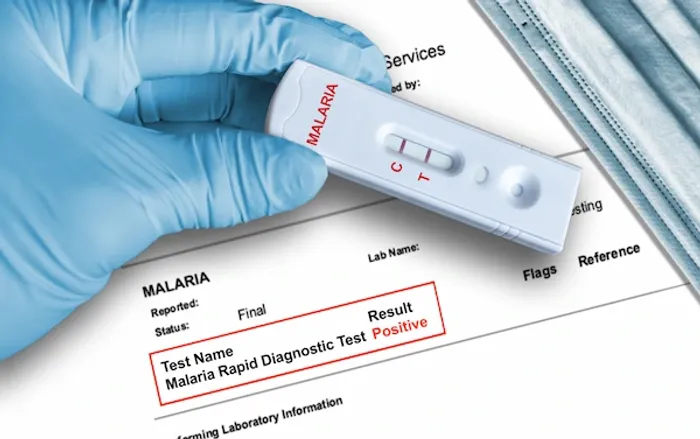
- Visual result: Both the control line (C) and the test line (T) appear. The intensity of the test line does not indicate severity.
- Interpretation: You have malaria and require immediate medical treatment.|
Understanding Species Identification (P. falciparum vs. Non-falciparum)
Combination RDTs have two test lines:
- P. falciparum (Pf) line positive: Indicates infection with Plasmodium falciparum, a medical emergency requiring artemisinin-based combination therapy (ACT).
- Pan-malaria line positive (Pf line negative): Suggests infection with a non-falciparum species, such as P. vivax, P. ovale, or P. malariae. Treatment varies by species.
Factors That Can Affect Your Test Results
Several factors can influence the accuracy of your RDT result.
1. Parasite Density and Test Sensitivity
Every RDT has a detection limit, usually between 50–200 parasites per microlitre of blood. If your parasite levels are below this, the test may return a false negative, even if you are infected.
2. Recent Infection and the Antigen "Window Period"
If you were only recently bitten by an infected mosquito, it takes time for the parasites to multiply to detectable levels. Testing too early in the incubation period (7–30 days) can produce a false negative. If your symptoms persist, consult a doctor online with Apollo24|7 for guidance and possible retesting.
3. Test Kit Quality and User Error
Using expired kits, exposing them to extreme conditions, or failing to follow the instructions (wrong blood sample size, incorrect waiting time) can compromise results.
What to Do After Getting Your Test Results
Understanding your malaria test results is the first step, but knowing what to do next is equally important. The right course of action depends on whether your test is positive, negative, or inconclusive.
Next Steps if Your Test is Positive
Seek immediate medical attention. A positive RDT is a clinical diagnosis in most settings. Treatment will be prescribed based on species identified and your medical history. Do not delay, as P. falciparum malaria can progress quickly.
Next Steps if Your Test is Negative (But You Still Have Symptoms)
A negative RDT does not always rule out malaria. If symptoms continue:
- Consult a doctor and share your travel and health history.
- A blood smear microscopy test may be recommended, the gold standard for malaria diagnosis. It can detect very low-level infections.
- Apollo24|7 offers home collection for confirmatory tests like blood smear microscopy, saving you unnecessary trips to a clinic.
Beyond the Rapid Test: Other Malaria Diagnostic Methods
While rapid diagnostic tests are widely used for their convenience, they are not the only option. Several other methods can provide deeper insights into malaria infection, its type, and severity.
1. Microscopy: The Gold Standard
This test involves staining and examining a blood smear under a microscope. It can confirm the species, measure parasite load (parasitaemia), and track treatment progress. However, it requires expertise and more time than an RDT.
2. Polymerase Chain Reaction (PCR) Test
PCR detects parasite DNA with very high sensitivity. It is the most accurate method for species identification and low-level infections but is usually reserved for research, confirmation, or complex cases due to higher costs.

Conclusion
Understanding your malaria antigen test results empowers you to make informed health decisions. A negative result is reassuring but not always conclusive, while a positive result demands immediate medical attention. RDTs are valuable for rapid screening, but their findings should always be confirmed by a healthcare professional who considers your symptoms, travel history, and risk factors.
If you remain unwell despite a negative test, seek medical advice without delay. Timely diagnosis and treatment are critical to recovery and to preventing severe complications. If you have travelled to a malaria-prone region and feel unwell, consult a doctor online with Apollo24|7 to arrange testing, including home collection for confirmatory blood smears. With prompt care and reliable information, malaria can be managed effectively and safely.
Consult Top General Physicians
Consult Top General Physicians


Dr. Syed Ismail Ali
General Practitioner
7 Years • MBBS
Hyderabad
Apollo 24|7 Clinic, Hyderabad

Dr D M Karthik
General Practitioner
4 Years • MBBS, Fellowship in Diabetes Mellitus, Advance certificate in Diabetes Mellitus, Derma Nutrition Certification
Visakhapatnam
Apollo 24|7 Clinic - Andhra Pradesh, Visakhapatnam

Dr. Chaithra H
General Physician/ Internal Medicine Specialist
6 Years • MBBS, MD General Medicine, DNB General Medicine
Bangalore
Apollo 24|7 Clinic - Karnataka, Bangalore

Dr. Mohammed Kamran
General Practitioner
5 Years • MBBS, FIDM
Nashik
Apollo 24|7 Clinic - Maharashtra, Nashik

Dr. Suraja Nutulapati
General Physician/ Internal Medicine Specialist
10 Years • MBBS, MD (Internal Medicine)
Hyderabad
Apollo 24|7 Clinic, Hyderabad

(1025+ Patients)
Consult Top General Physicians
Dr. Syed Ismail Ali
General Practitioner
7 Years • MBBS
Hyderabad
Apollo 24|7 Clinic, Hyderabad
Dr D M Karthik
General Practitioner
4 Years • MBBS, Fellowship in Diabetes Mellitus, Advance certificate in Diabetes Mellitus, Derma Nutrition Certification
Visakhapatnam
Apollo 24|7 Clinic - Andhra Pradesh, Visakhapatnam
Dr. Chaithra H
General Physician/ Internal Medicine Specialist
6 Years • MBBS, MD General Medicine, DNB General Medicine
Bangalore
Apollo 24|7 Clinic - Karnataka, Bangalore
Dr. Mohammed Kamran
General Practitioner
5 Years • MBBS, FIDM
Nashik
Apollo 24|7 Clinic - Maharashtra, Nashik
Dr. Suraja Nutulapati
General Physician/ Internal Medicine Specialist
10 Years • MBBS, MD (Internal Medicine)
Hyderabad
Apollo 24|7 Clinic, Hyderabad
(1025+ Patients)
Frequently Asked Questions
Can a malaria test be negative even if I have malaria?
Yes. This is called a false negative and may occur due to low parasite levels, faulty kits, or parasite mutations.
How long after a mosquito bite will a malaria test show positive?
The incubation period usually ranges from 7 to 14 days. Tests are most reliable after symptoms appear.
What does a faint line on a malaria rapid test mean?
Any visible line in the test region is considered positive, regardless of its faintness.
How long do malaria antigens stay in the blood after treatment?
HRP-2 antigens may linger for weeks, while pLDH antigens usually disappear within days once parasites are cleared.
Which is more accurate: rapid test or blood smear?
Blood smear microscopy is more accurate and is the gold standard, though RDTs remain valuable for quick and accessible testing.