



All About Surya Namaskar: Benefits, Steps & Safety Tips
Discover Surya Namaskar benefits, clear Sun Salutation steps, and safety tips. Learn how yoga for health boosts strength, flexibility, and calm.

Written by Dr. Vasanthasree Nair
Reviewed by Dr. Md Yusuf Shareef MBBS, Advanced Certificate Course in Dermatology
Last updated on 14th Jan, 2026
Introduction
Surya Namaskar, or Sun Salutation, is a classic sequence of yoga poses practised around the world. People love it because it can be done almost anywhere, takes just a few minutes, and works the whole body. In this guide, you’ll find a simple, science-informed look at Surya Namaskar benefits, easy Sun Salutation steps with breath cues, and practical safety tips. If you’re curious about yoga for health, whether to improve flexibility, build strength, or reduce stress, this is a friendly place to start.
Consult a Top General Practitioner for Personalised Advice
What Is Surya Namaskar? A Quick Overview of Yoga for Health
Surya Namaskar (Sun Salutation) is a flowing sequence of postures linked with the breath. Traditionally practised in the morning, it can also be done any time of day as a warm-up or a standalone practice. The sequence moves your spine through flexion, extension, and neutral positions; wakes up major muscle groups; and gently raises your heart rate.
Why it Matters:
- It’s efficient: one short sequence can engage strength, flexibility, balance, and coordination.
- It’s adaptable: you can slow it down (for mobility and calm) or speed it up (for more intensity). It’s
- scalable: beginners can use props and modifications; experienced practitioners can go deeper.
Evidence-Based Surya Namaskar Benefits
While Surya Namaskar has yogic roots, many of its commonly reported benefits line up with what large health organisations say about physical activity and mind-body practices.
Physical Benefits
- Flexibility and mobility: Regular practice helps lengthen and mobilise the hamstrings, calves, hips, shoulders, and spine. Major medical centres note that yoga tends to improve flexibility and joint range of motion over time.
- Strength and balance: Plank, lunges, and controlled transitions engage core, legs, shoulders, and back. Yoga is recognised for improving balance and functional strength, especially helpful as we age.
- Posture and body awareness: Repeated alignment cues (neutral spine, engaged core, shoulders away from ears) can support better posture and movement mechanics.
- Heart health complement: Done at a steady pace, Sun Salutations can modestly elevate heart rate. While they don’t replace brisk aerobic exercise, they can complement an overall heart-healthy routine.
Mental Well-Being
- Stress relief: Coordinating breath with movement can activate the body’s relaxation response and reduce perceived stress.
- Mood and focus: Mindful movement may help support mental clarity and a calmer mood, with many people reporting an improved sense of well-being after yoga.
- Sleep support: Relaxation and gentle activity earlier in the day may contribute to better sleep for some people.
Functional Fitness For Daily Life
- Easier bending, lifting, reaching: The sequence mirrors everyday motions, helping you move more comfortably and safely.
- Coordination and rhythm: Breath-led movement builds rhythm and motor control.
Note: Benefits vary by individual, pace, and consistency. Yoga is generally considered safe for most healthy adults when practised correctly.
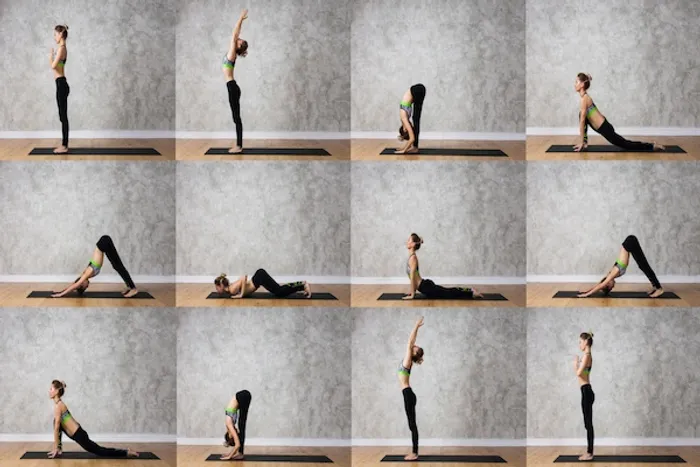
Sun Salutation Steps: A Simple 12-Pose Sequence with Breath Cues
Below is a classic 12-step Hatha Surya Namaskar. Move smoothly, aim for even breathing, and never force a shape. If you’re new, go slowly and use props (like yoga blocks).
- Step 1 – Mountain with Prayer (Tadasana/Pranamasana)
Stand tall, feet hip-width or together, palms at heart. Soften shoulders and steady your breath.
- Step 2 – Inhale: Raised Arms Pose (Hasta Uttanasana)
Sweep arms overhead. Lengthen through the sides of your waist. Option: tiny backbend by lifting the chest, keeping the neck long.
- Step 3 – Exhale: Standing Forward Fold (Uttanasana)
Hinge at the hips with a long spine. Bend knees as needed to avoid pulling on the lower back or hamstrings. Hands to the floor, shins, or blocks.
- Step 4 – Inhale: Low Lunge (Ashwa Sanchalanasana)
Step your right leg back. Left knee over left ankle. Lift chest forward; keep hips level. Option: lower the right knee to the floor.
- Step 5 – Exhale: Plank (Phalakasana)
Step the left foot back. Wrists under shoulders, core engaged, body in one line. Option: drop knees for support.
- Step 6 – Exhale to Knees–Chest–Chin (Ashtanga Namaskara)
Lower knees, then chest and chin to the floor with hips slightly lifted, elbows close. Option: lower to the floor in one piece (chaturanga variation) with knees down for safety.
- Step 7 – Inhale: Cobra (Bhujangasana)
Slide the chest forward, lift to a gentle cobra with elbows bent, shoulders down. Keep the pubic bone grounded; avoid compressing the lower back.
- Step 8 – Exhale: Downward-Facing Dog (Adho Mukha Svanasana)
Lift your hips up and back. Hands shoulder-width, feet hip-width. Bend knees if hamstrings are tight. Press through palms, lengthen the spine.
- Step 9 – Inhale: Low Lunge (opposite side)
Step the right foot forward between your hands. Right knee over ankle.
Option: lower the back knee.
- Step 10 – Exhale: Standing Forward Fold (Uttanasana)
Step the left foot forward, fold. Knees can stay bent.
- Step 11 – Inhale: Raised Arms Pose (Hasta Uttanasana)
Rise with a long spine, sweep arms overhead.
- Step 12 – Exhale: Mountain with Prayer (Tadasana/Pranamasana)
Hands return to the heart. Stand tall and breathe.
Tip: On your next round, step the left leg back in Step 4 to even things out.
Pace, Repeats, and Breathing
- How many rounds: Start with 2–4 rounds. Over time, many people enjoy 6–12 rounds at a comfortable pace.
- Breathing: Move with a smooth inhale or exhale for each step. Avoid holding your breath.
- Tempo: Slower pace emphasises mobility and calm; faster pace demands more strength and stamina.
Safety Tips, Modifications, and When to See a Clinician?
Yoga is generally safe for most healthy adults, but a few smart precautions will help you practice comfortably.
General safety
- Warm up gently: March in place, roll your shoulders, and take a few easy cat-cow movements.
- Honour your range: Bending the knees and using blocks makes forward folds and lunges safer.
- Neutral neck: In cobra and down dog, keep the neck long; avoid dropping the head.
- Joint alignment: In lunges, keep the front knee stacked over the ankle. In planks, stack your shoulders over your wrists and engage your core.
Common modifications
- Wrists: Use fists, forearms (forearm plank), or wedges; distribute weight across the whole hand.
- Back comfort: Soften knees in forward folds; choose a low cobra over a high one.
- Shoulders: Keep elbows close in lowering phases; drop knees to reduce load.
- Hamstrings: Use blocks under your hands and bend your knees to protect the lower back.
When to Consult a Healthcare Provider?
See a health care provider when:
- Uncontrolled high blood pressure, cardiovascular or respiratory conditions: Move gently, avoid breath holding, and check what intensity is appropriate.
- Pregnancy: Prenatal guidance is recommended. Avoid deep backbends and prolonged lying flat on your back after the first trimester; make room for your belly in forward folds and lunges.
- Glaucoma or eye concerns: Head-down positions can increase eye pressure temporarily; ask your eye doctor which poses are appropriate.
- Recent injuries or surgery, osteoporosis with fracture risk, significant wrist/shoulder/knee pain, or chronic back issues: Get personalised guidance and use modifications.
Stop if you feel sharp pain, dizziness, chest pain, or unusual shortness of breath. Ease is the goal; discomfort is a cue to modify.
How Surya Namaskar Fits in a Balanced Routine?
Sun Salutations are a versatile part of yoga for health, but most people benefit from a well-rounded plan.
- For heart health: Add moderate-intensity aerobic activity (e.g., brisk walking, cycling) most days of the week, per public health guidelines.
- For strength: Include resistance or bodyweight training for major muscle groups at least twice weekly. Slow, controlled Sun Salutations can contribute, but dedicated strength work adds more.
- For mobility and balance: Keep yoga in the mix on multiple days. The combination of breath, balance, and flexibility is especially helpful as we age.
- For recovery: On busy days, 5–10 minutes of Sun Salutations can refresh you without overloading your schedule.
Common Mistakes to Avoid
- Rushing the breath: Sync each movement to an inhale or exhale; slow and steady builds more benefit.
- Locking joints: Keep a micro-bend in elbows and knees to protect ligaments.
- Collapsing into the low back: In backbends, lengthen through the spine and engage the core and glutes lightly.
- Shoulders hunching toward ears: Soften and broaden your collarbones, especially in plank and cobra.
- Overstriding in lunges: Shorten your stance if the front knee drifts past toes or if your hips tilt.
Quick Plan for Beginners
The Quick plan includes:
- Frequency: 3–5 days per week.
- Session length: 5–15 minutes to start (2–6 rounds), then expand as you feel ready.
- Intensity: Start slow, focus on alignment, and build up gradually.
- Add-ons: Finish with a few gentle stretches and 1–3 minutes of quiet breathing or relaxation.
Key Takeaways
- Surya Namaskar benefits include improved flexibility, functional strength, balance, and stress relief.
- Learn the Sun Salutation steps slowly, using breath cues and supportive modifications.
- Practice safely: align joints, avoid forcing positions, and check with a clinician if you have medical conditions.
- Pair Sun Salutations with cardio and strength training for a balanced, sustainable approach to health.
Consult a Top General Practitioner for Personalised Advice
Consult a Top General Practitioner for Personalised Advice

Dr Suseela
General Physician
5 Years • MBBS
Bengaluru
Apollo Medical Center, Marathahalli, Bengaluru

Dr. Rajib Ghose
General Physician/ Internal Medicine Specialist
25 Years • MBBS
East Midnapore
VIVEKANANDA SEBA SADAN, East Midnapore

Dr Varun Panicker
General Physician/ Internal Medicine Specialist
6 Years • MBBS
Bengaluru
Apollo Clinic, JP nagar, Bengaluru

(25+ Patients)

Dr. Arthi S
Family Physician
3 Years • MBBS
Bengaluru
PRESTIGE SHANTHINIKETAN - SOCIETY CLINIC, Bengaluru

Dr. Ashita Kuruvilla
General Practitioner
7 Years • MBBS
Kolkata
KVC CLINIC, Kolkata
Consult a Top General Practitioner for Personalised Advice
Dr Suseela
General Physician
5 Years • MBBS
Bengaluru
Apollo Medical Center, Marathahalli, Bengaluru
Dr. Rajib Ghose
General Physician/ Internal Medicine Specialist
25 Years • MBBS
East Midnapore
VIVEKANANDA SEBA SADAN, East Midnapore
Dr Varun Panicker
General Physician/ Internal Medicine Specialist
6 Years • MBBS
Bengaluru
Apollo Clinic, JP nagar, Bengaluru
(25+ Patients)
Dr. Arthi S
Family Physician
3 Years • MBBS
Bengaluru
PRESTIGE SHANTHINIKETAN - SOCIETY CLINIC, Bengaluru
Dr. Ashita Kuruvilla
General Practitioner
7 Years • MBBS
Kolkata
KVC CLINIC, Kolkata
More articles from General Medical Consultation


Frequently Asked Questions
Is Surya Namaskar enough for daily exercise?
It’s a great foundation for mobility, balance, and light-to-moderate effort. For comprehensive fitness, include regular aerobic activity and strength work each week, as major health organisations recommend.
Can Surya Namaskar help with weight management?
It can contribute to energy expenditure and muscle conditioning, especially at a brisk but safe pace. Lasting weight management also depends on overall activity levels, nutrition, sleep, and stress.
I have a stiff back. Can I do Sun Salutations?
Often yes, with modifications. Keep knees bent in forward folds, choose a gentle cobra, and move slowly. If you have active back pain, disc issues, or a recent injury, check with a clinician or a qualified yoga professional first.
What if I can’t touch my toes?
No problem. Bend your knees, place your hands on your shins or blocks, and focus on a long spine. Flexibility improves over time; forcing stretches can backfire.
When is the best time to practice?
Many people enjoy mornings, but the “best” time is when you can be consistent. Practice on an empty stomach, and give yourself a few minutes to warm up.